EN
Polyester Fiber Manufacturing Process: Melting, Spinning and Drawing Explained
Making polyester fiber is often described as a simple sequence: melt the polymer, spin it into filaments, and stretch it. That overview is useful, but it hides the interfaces that determine whether the process can be controlled consistently. From a fiber-process technical advisory perspective, making polyester fiber starts with the feedstock condition and target fiber specification, not with an isolated machine feature list.
For staple-fiber production, each stage changes what the next stage can achieve. Polymer preparation affects melt stability; spinning establishes the first filament geometry; cooling and take-up influence the as-spun structure; and drawing develops orientation that supports the intended fiber behavior. The exact operating window depends on polymer grade, target denier, cross-section, intended use, and plant conditions, so this article explains the logic rather than promising a universal recipe.
What does making polyester fiber involve?
At a high level, making polyester fiber converts a polyester melt into continuous filaments and then into a controlled fiber form. A typical flow includes material preparation, melting and filtration, metering, melt spinning through a spinneret, quenching, take-up, drawing, heat treatment, crimping where required, cutting for staple fiber, and final inspection or baling.
At first this looks like a machine-selection issue; more precisely, it is a process-and-interface selection issue. By process interface, we mean the handoff points where material, utilities, controls, or responsibilities connect. A spinning position may be well specified, for example, while material drying, quench-air stability, or downstream handling still needs confirmation.
1. Prepare polyester material before the melt stage
Making polyester fiber begins with defining the incoming polymer and its condition. Depending on the production route, the input may be virgin polymer chips, recycled PET-derived material after appropriate preparation, or melt supplied from an upstream polymerization system. The important planning question is not simply whether the material is called polyester; it is whether its condition is suitable for the proposed process and target fiber range.
For chip-based routes, drying and material handling are commonly reviewed before melting. Moisture management, contamination control, lot consistency, conveying, and storage practices can affect downstream stability. If the feedstock condition varies, the evaluation should include input-quality questions before drawing process conclusions. Treating feedstock as a design input rather than a background assumption helps keep making polyester fiber connected to the actual production objective.
2. Melt, filter, and meter the polymer
In the melt section, polyester is heated until it can flow through the process. The melt is commonly filtered and delivered under controlled conditions to the spinning system. Filtration is not only an equipment item; it is part of protecting the continuity of the melt path and helping avoid issues that may appear later at the spinneret.
Metering establishes a repeatable flow to each spinning position. In making polyester fiber, the relationship between melt condition, filtration, pressure behavior, and metering deserves attention because variation at this point can carry into filament formation. Useful operating descriptions therefore connect the melt stage to observable signals such as temperature, pressure trend, throughput consistency, and the documented response to deviations.
3. Form filaments in the melt spinning process
The melt spinning process forms the initial filaments. Molten polymer passes through small capillaries in a spinneret, creating multiple fine streams. Those streams leave the spinneret as hot melt and begin transitioning toward filaments as they move through the cooling zone. This is the visual core of making polyester fiber, but it works only because the preparation and melt-delivery stages have already created suitable conditions.
Spinneret design, polymer flow, and the surrounding cooling environment all influence the early filament state. It is more useful to ask which fiber specification the spinning arrangement is intended to support than to call one configuration universally better. A narrower equipment question often becomes clearer after mapping upstream material preparation and downstream drawing interfaces.
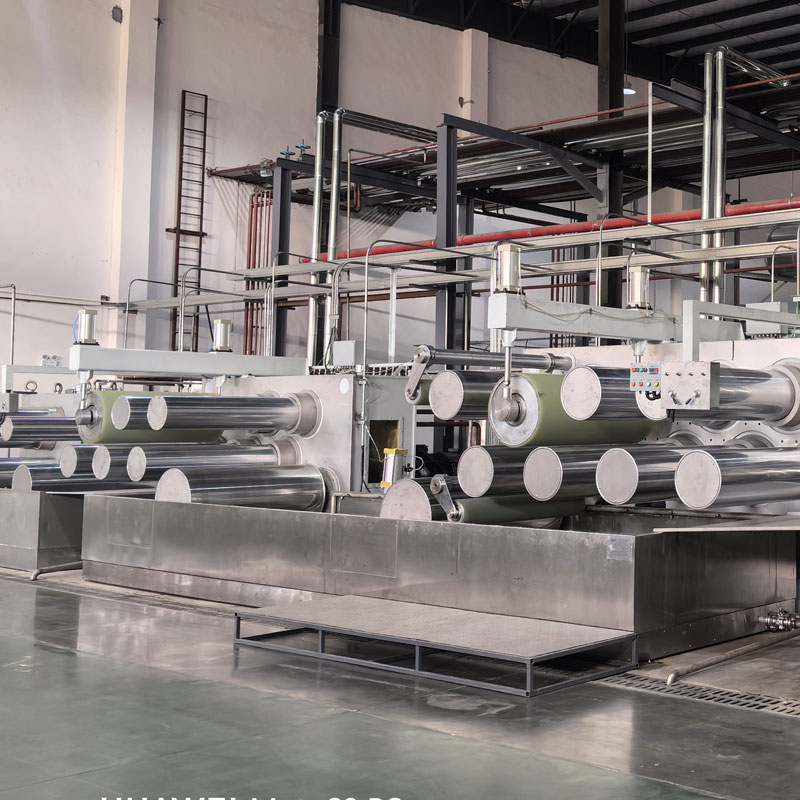
 A conceptual view of the melt spinning and early filament-handling stages.
4. Cool and take up the as-spun filaments
After extrusion, cooling air removes heat so the filaments can solidify sufficiently for collection. Quench conditions should be considered with airflow distribution, ambient conditions, filament path, and the intended processing speed in mind. The take-up system then guides and collects the as-spun material for the next operation.
Making polyester fiber at this point is not yet the same as achieving the final staple-fiber structure. The as-spun state carries a process history into drawing. A practical observation is that early questions often reveal missing process information, not missing equipment: What cooling conditions are being monitored? How is filament tension observed? Which variations require an operator response? These questions make the quality loop visible without claiming a particular plant outcome.
5. Use fiber stretching technology to develop orientation
Fiber stretching technology, usually called drawing, pulls the filaments in a controlled manner. Drawing aligns polymer chains more strongly along the fiber axis and can increase molecular orientation and crystallinity. It also reduces fiber diameter. That is why drawing is a structural-development stage in making polyester fiber, not merely a transport step between spinning and finishing.
The draw ratio, temperature profile, tension control, and material condition need to work together. A higher setting is not automatically a better setting; the final assessment depends on the fiber specification and site conditions. Instead of listing settings out of context, a useful polyester production method asks how the selected conditions will be verified through sampling, observations, and finished-fiber evaluation.
6. Heat-set, crimp, cut, and package staple fiber
For many staple-fiber applications, making polyester fiber continues through thermal treatment, crimp development, tow handling, cutting, and baling. Heat treatment can be used to stabilize the developed structure under the selected route. Crimping can contribute bulk or cohesion characteristics for downstream processing, while cutting establishes the target staple length. The correct sequence and conditions depend on the intended product, so these steps should be tied back to the production specification rather than treated as identical for all synthetic fibers.
When reviewing this part of making polyester fiber, attention often shifts from individual units to the handoff points between them. Material transfer, tension management, dust control, collection, labeling, and access for routine maintenance may all influence practical operability. A detailed equipment description can still leave decisive project interfaces unexplained.
7. Close the loop with quality checks
Making polyester fiber should include a defined quality loop rather than an end-of-line guess. Teams may review items such as linear density, length distribution, crimp-related measures, appearance, moisture, and other properties relevant to the product specification. The point is not to imply that every line measures every item in the same way; it is to connect each process stage with how output is evaluated.
This feedback helps engineering and operations teams decide whether an observed change is linked to material condition, melt delivery, spinning, cooling, drawing, or downstream finishing. Before stating that a configuration meets a requirement, identify the documents, tests, or engineering review that would verify it.
A practical checklist for discussing a polyester production method
- What polymer source, condition, and fiber specification define the starting point for making polyester fiber?
- Which melt, filtration, and metering conditions need to remain observable?
- How will the melt spinning process and quench zone be matched to the intended filament path?
- Which fiber stretching technology controls will be evaluated against the target fiber form?
- What downstream treatment, cutting, handling, and quality checks are within the project scope?
- Which utilities, controls, documents, training needs, and maintenance interfaces still require confirmation?
From a process explanation to a planning discussion
Making polyester fiber can be viewed as a connected chain of material, thermal, mechanical, and quality decisions. Melting creates a manageable polymer flow; the melt spinning process establishes filament formation; cooling and take-up preserve a usable as-spun state; and drawing develops structure through controlled fiber stretching technology. Downstream finishing then turns that structure into a product form that can be checked against a defined specification.
For a production project, the most useful next step is usually to document the intended fiber range, feedstock condition, output checks, and interfaces before comparing line concepts. Suzhou Soft Gem can frame a process-package discussion around those questions, subject to project-specific engineering confirmation. That may be the right direction, although the final assessment depends on the fiber specification, material condition, utilities, and site constraints.


 Hot News