EN
Fiber Making Machine Working Principle and Production Process
A fiber making machine is not one isolated unit. In a melt-spun staple-fiber project, it is a linked process that receives polymer feedstock, prepares a stable melt, forms filaments, develops the tow, and finishes the fibers for the intended application. For a technical buyer, the useful starting point is the production objective: material type, fiber form, target specification, and the connections the site can support.
From a fiber-process technical advisory perspective, a fiber making machine should be reviewed as a process package rather than as a single feature list. The same phrase can describe very different equipment, including PET-to-fiber systems, staple-fiber lines, opening equipment, or specialty ball-fiber machinery. This article focuses on the working logic of a melt-spun staple fiber production line.
What Is the Working Principle of a Fiber Making Machine?
The central principle is controlled conversion: polymer is brought to a condition suitable for flow, pushed through a forming element, cooled into continuous filaments, then treated to create the structure needed for downstream use. A fiber making machine therefore coordinates material flow, heat, pressure, motion, cooling, and control signals. A change at one handoff can affect the next stage, which is why a line should be evaluated as a system.
At first this looks like a machine-selection issue; more precisely, it is a process-and-handoff selection issue. The polymer grade, feedstock condition, spinneret concept, quench arrangement, draw path, finish, and cutting plan all need to fit together. A fiber making machine does not establish a final fiber outcome by itself; confirmation depends on the material, process settings, quality plan, and site conditions.
Core Modules in a Fiber Production Line
Material preparation and feeding
The first section of a fiber making machine handles the feedstock before it reaches the melt system. Depending on the project, this may include conveying, dosing, drying, filtering, or other preparation steps. Feedstock variation matters, especially where recycled material is under consideration. The useful shift is to treat feedstock as a design input, not a background assumption. Teams should define what incoming-material information is available and how it will be checked before comparing downstream equipment.
Extrusion, melt conditioning, and filtration
In the fiber extrusion section, polymer is heated and conveyed as a melt. The extrusion and melt-conditioning path needs to provide stable flow to the spinning assembly while allowing the project team to review temperature, pressure, filtration, and maintenance connections. For a fiber making machine, these are not merely component labels: they are operating questions that affect how consistently the next stage can be supplied.
Spinning and filament formation
Spinning technology turns the conditioned melt into many fine continuous filaments. The melt is distributed to a spinneret, where the hole configuration helps establish the initial filament geometry. The emerging filaments are cooled and gathered into a tow. A fiber making machine should be assessed with the planned material and fiber form in mind, because the appropriate spinning arrangement is dependent on the specification rather than on a universal configuration.
Drawing, heat treatment, and tow control
After formation, the tow passes through a drawing path. In broad process terms, drawing helps orient the polymer structure and develops the tow before later finishing operations. This stage relies on controlled tension, speed relationships, temperature management, and stable tow handling. A fiber making machine may use rollers, godets, guides, and associated controls to manage that path. A stated capacity does not by itself answer whether utilities, controls, and handling connections are ready to support it.
Crimping, finishing, cutting, and packaging
Where staple fiber is required, the tow is commonly processed after drawing through operations such as crimping, finish application, relaxation or heat treatment, cutting, and bale handling. Crimping and cutting distinguish this part of a staple fiber production line from a system intended only to wind continuous filament. The exact route should reflect the desired product and be confirmed during engineering review. In a fiber making machine, downstream handling deserves the same attention as the spinning section because poor handoffs can complicate quality control and routine operation.
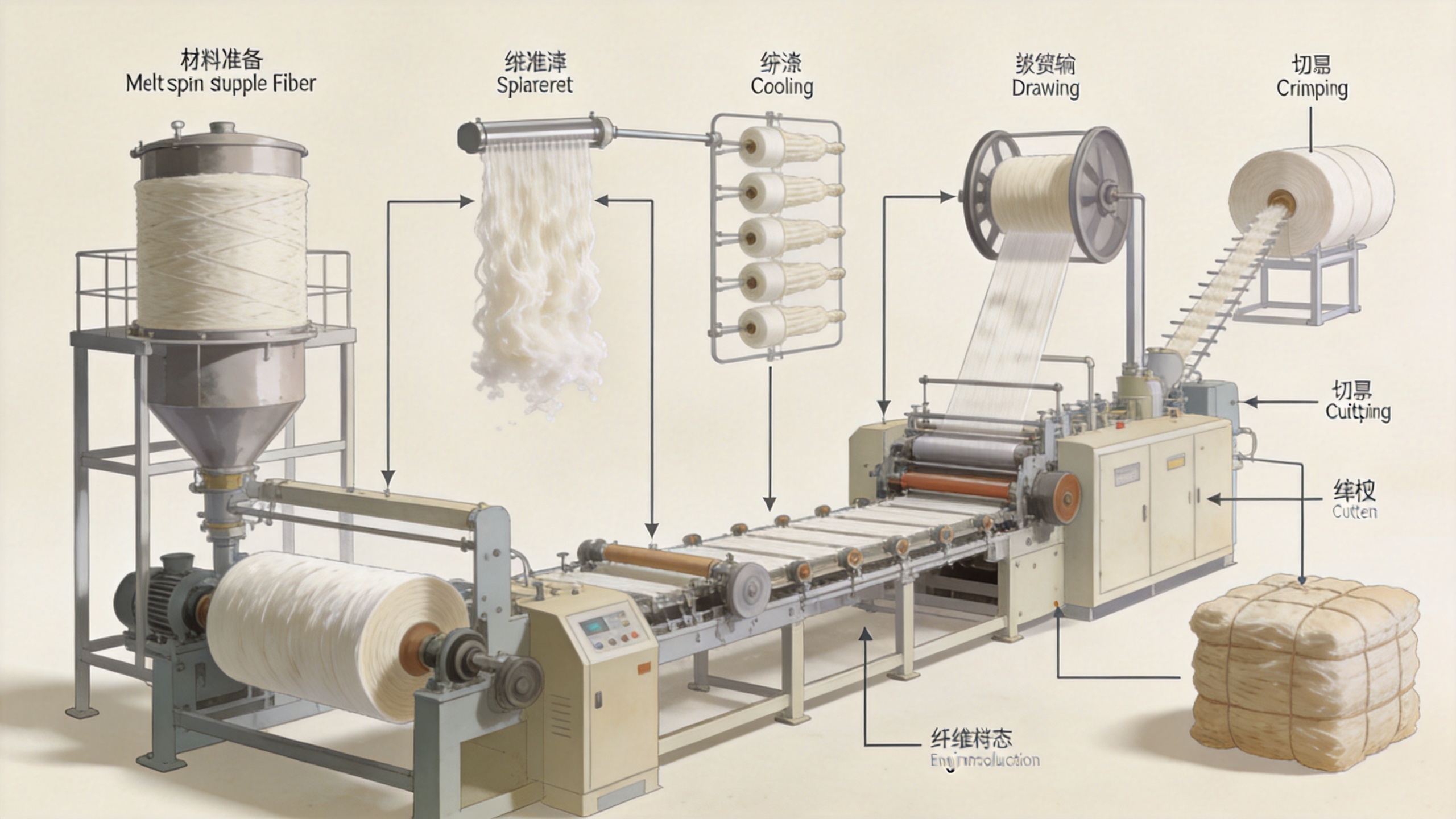
Typical Manufacturing Process: A Practical Sequence
- Define feedstock and fiber requirements. Record the polymer type, expected input condition, target fiber form, and application boundary before choosing the process package.
- Prepare and meter material. The fiber making machine receives material through the preparation and feeding section so the melt stage has an appropriate input.
- Carry out fiber extrusion. The polymer is melted, conveyed, conditioned, and filtered before it reaches the spinning assembly.
- Form and cool filaments. The spinning technology section distributes melt to the spinneret, then cools and gathers the filaments into tow.
- Draw and stabilize the tow. The tow follows a controlled path to prepare it for the requested downstream conversion route.
- Convert to staple fiber when required. A staple-focused fiber making machine may crimp, apply finish, cut, and pack the processed tow.
- Verify and document. Define the checks, sampling points, acceptance criteria, and handover records that are appropriate for the project.
How to Review a Fiber Making Machine Before Engineering Confirmation
Instead of asking only which fiber making machine has the longest equipment list, ask which process questions it answers. What feedstock range is intended? What fiber form and application are being considered? Which utilities, layout constraints, automation boundaries, and maintenance responsibilities need site confirmation? By process handoff, we mean the connection points where material, utilities, controls, or responsibilities connect.
A practical review of a fiber making machine can include:
- the material-preparation boundary and available input information;
- the relationship between fiber extrusion, filtration, and spinneret access;
- the intended spinning technology and cooling or tow-gathering arrangement;
- the drawing, crimping, cutting, and packing sequence required for the target fiber;
- control points, quality checks, utilities, safety review, and commissioning responsibilities; and
- the scope documents needed to compare one fiber production line concept with another.
For project-planning discussions, Soft Gem states an overall fiber-material plant solution context that can help organize questions about process packages and engineering handoffs. That context is a starting point for a scoped technical conversation, not a substitute for project-specific documentation or validation.
From Machine Description to Production Decision
A fiber making machine is most useful when the line concept can be traced from input material to a defined fiber-handling outcome. The next question is not which option sounds more advanced, but which one fits the stated production objective. Review the full manufacturing process, identify the connections that need evidence, and request a process discussion that reflects the actual material, product, and site boundary.
For a new or modified fiber production line, this approach helps engineering, production, quality, and procurement teams use the same sequence of questions. It also keeps the fiber making machine evaluation grounded in what must be confirmed before a line configuration is finalized.




 Hot News